11.04.2025
An unforgettable Easter in Spain during Semana Santa
In Spain, Easter is by far the most important holiday, and it is celebrated very differently than in Poland. It is not only a religious observance, but a week-long spectacle known as Semana Santa, combining deep tradition, a strong sense of community, and remarkable artistic craftsmanship. Even if you are not a religious person, Spain’s Easter traditions are likely to move you with their intensity, respect for history, and the unique atmosphere of Andalusia. It is without doubt an extraordinary experience.
Semana Santa (Holy Week)
Beyond the shared liturgical ceremonies, each region of Spain cultivates its own unique traditions and rituals. In the heart of Castilian Spain, Holy Week unfolds in reflection, silence, and restraint, while in sunny Andalusia and vibrant Valencia the processions burst with color, flamenco music, and joyful celebration.
In Malaga, a remarkable ritual takes place involving the symbolic release of a prisoner, whose departure from prison is blessed by the figure of Jesus as an act of divine mercy. In the historic city of Cuenca, sacred music concerts resonate throughout the entire week, giving the celebrations a profound and deeply moving character.
The importance and extraordinary nature of this festival are evidenced, among other things, by the fact that it has been inscribed on the UNESCO World Heritage list.
In Malaga, a remarkable ritual takes place involving the symbolic release of a prisoner, whose departure from prison is blessed by the figure of Jesus as an act of divine mercy. In the historic city of Cuenca, sacred music concerts resonate throughout the entire week, giving the celebrations a profound and deeply moving character.
The importance and extraordinary nature of this festival are evidenced, among other things, by the fact that it has been inscribed on the UNESCO World Heritage list.
Semana Santa – day by day
Although each town in Spain adds its own touch of magic to Semana Santa, the overall schedule of the celebrations remains broadly similar:
◉ From Domingo de Ramos – Palm Sunday
- The streets come alive with a joyful atmosphere. The faithful decorate church entrances with olive branches and intricately woven palms, taking part in colorful processions that commemorate Jesus’ triumphant entry into Jerusalem.
◉ On Holy Monday, Tuesday, and Wednesday
- Processions continue to pass through the cities, but in a more intimate and restrained form, inviting participants to reflection ahead of the days of culmination.
◉ Jueves Santo – Holy Thursday
– This evening commemorates the Last Supper. After dusk, monumental platforms take to the streets, while choral singing blends with the soft, rhythmic steps of the costaleros, the men carrying the massive floats bearing figures of Jesus and Mary.
◉ Viernes Santo – Good Friday
- This is the moment of deepest contemplation. Processions often move in complete silence, and each platform recalls the imprisonment and crucifixion of Christ.
◉ On Holy Saturday – Sábado de Gloria
- Spaniards usually remain in quiet reflection. Although processions pause in many cities, nighttime vigils in churches illuminated by hundreds of candles announce the coming joy of the Resurrection.
◉ On Domingo de Pascua – Easter Sunday
– The triumph of life fills the streets. Processions take on a festive and joyful character, often ending with the symbolic meeting of the figures of the Virgin Mary and the Risen Christ.
◉ In some European countries, such as Poland, Easter Monday is a public holiday.
- In Spain, however, after an eventful Sunday, daily routines resume and everyone returns to work.
◉ From Domingo de Ramos – Palm Sunday
- The streets come alive with a joyful atmosphere. The faithful decorate church entrances with olive branches and intricately woven palms, taking part in colorful processions that commemorate Jesus’ triumphant entry into Jerusalem.
◉ On Holy Monday, Tuesday, and Wednesday
- Processions continue to pass through the cities, but in a more intimate and restrained form, inviting participants to reflection ahead of the days of culmination.
◉ Jueves Santo – Holy Thursday
– This evening commemorates the Last Supper. After dusk, monumental platforms take to the streets, while choral singing blends with the soft, rhythmic steps of the costaleros, the men carrying the massive floats bearing figures of Jesus and Mary.
◉ Viernes Santo – Good Friday
- This is the moment of deepest contemplation. Processions often move in complete silence, and each platform recalls the imprisonment and crucifixion of Christ.
◉ On Holy Saturday – Sábado de Gloria
- Spaniards usually remain in quiet reflection. Although processions pause in many cities, nighttime vigils in churches illuminated by hundreds of candles announce the coming joy of the Resurrection.
◉ On Domingo de Pascua – Easter Sunday
– The triumph of life fills the streets. Processions take on a festive and joyful character, often ending with the symbolic meeting of the figures of the Virgin Mary and the Risen Christ.
◉ In some European countries, such as Poland, Easter Monday is a public holiday.
- In Spain, however, after an eventful Sunday, daily routines resume and everyone returns to work.
Semana Santa processions
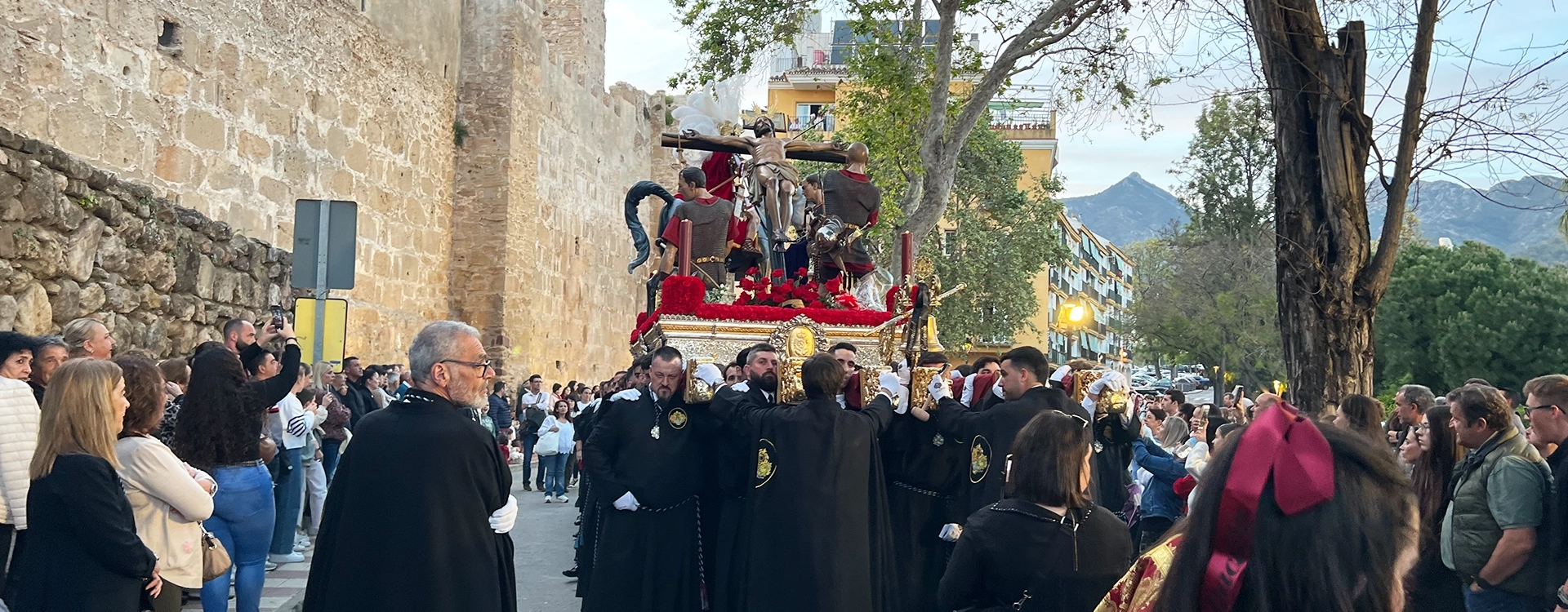
Each procession tells a separate biblical story, presented with remarkable intensity on impressive platforms known as pasos. These hand-crafted altars, featuring intricately carved figures of the Virgin Mary and Jesus, are created through the collective effort of the entire parish community. Some of them weigh up to 1.5 tons and are carried on the heads and shoulders of the costaleros. For them, this is both an honor and a profound expression of devotion to tradition.
When a paso emerges from the church, it begins a long journey through the city’s main streets, often lasting several hours. During brief stops, spectators can admire the extraordinary details of the decorations, from floral garlands to gilded sculptural elements. The costaleros, encouraged by the cheering crowd, follow the guidance of the capataz, who sets the rhythm with sharp calls, giving pace and motivation with every step.
This moment, filled with focus and emotion, remains in memory as one of the most powerful experiences of Semana Santa in Spain.
In Andalusia, it sometimes happens that during a procession someone steps out onto a balcony and performs a deeply moving song without any accompaniment. This is known as flamenco jondo, whose character recalls the Arabic calls of muezzins. In the silence, broken only by the human voice, the procession comes to a halt, and when the final note fades away, it moves on again, as if reborn with new spiritual energy.
When a paso emerges from the church, it begins a long journey through the city’s main streets, often lasting several hours. During brief stops, spectators can admire the extraordinary details of the decorations, from floral garlands to gilded sculptural elements. The costaleros, encouraged by the cheering crowd, follow the guidance of the capataz, who sets the rhythm with sharp calls, giving pace and motivation with every step.
This moment, filled with focus and emotion, remains in memory as one of the most powerful experiences of Semana Santa in Spain.
In Andalusia, it sometimes happens that during a procession someone steps out onto a balcony and performs a deeply moving song without any accompaniment. This is known as flamenco jondo, whose character recalls the Arabic calls of muezzins. In the silence, broken only by the human voice, the procession comes to a halt, and when the final note fades away, it moves on again, as if reborn with new spiritual energy.
Brotherhoods
Thanks to the penitential brotherhoods known as cofradías or hermandades, Semana Santa gains its unique and unmistakable character. These associations, whose traditions date back as far as the 15th and 16th centuries, bring together both clergy and lay members of a given parish, preserving for generations a strict code of customs, robe colors, and distinctive insignia.
Members of the brotherhoods, called nazarenos, wear characteristic white or black tunics and pointed hoods that cover their faces except for the eyes. They carry long candles, crosses, or the emblems of their community. Belonging to a brotherhood is, for many, a great honor and a form of spiritual penance, a sign of devotion passed down from generation to generation.
When the monumental pasos emerge from the darkness of the church, a true mystery of art and faith begins. Each platform can weigh up to 1.5 tons, and carrying them on the shoulders of the costaleros is one of the most spectacular and moving experiences of Semana Santa. The procession, sometimes lasting many hours, follows routes chosen by each brotherhood. More than 70 brotherhoods and around 50,000 participants create a spectacle that attracts crowds of spectators day and night.
The entire procession is directed by the capataz, whose commands set the rhythm and give strength to those carrying the platforms. The cheering crowd amplifies the uniqueness of the celebration and the respect for tradition, especially in the heart of Andalusia, where Easter becomes a true, living legend.
Members of the brotherhoods, called nazarenos, wear characteristic white or black tunics and pointed hoods that cover their faces except for the eyes. They carry long candles, crosses, or the emblems of their community. Belonging to a brotherhood is, for many, a great honor and a form of spiritual penance, a sign of devotion passed down from generation to generation.
When the monumental pasos emerge from the darkness of the church, a true mystery of art and faith begins. Each platform can weigh up to 1.5 tons, and carrying them on the shoulders of the costaleros is one of the most spectacular and moving experiences of Semana Santa. The procession, sometimes lasting many hours, follows routes chosen by each brotherhood. More than 70 brotherhoods and around 50,000 participants create a spectacle that attracts crowds of spectators day and night.
The entire procession is directed by the capataz, whose commands set the rhythm and give strength to those carrying the platforms. The cheering crowd amplifies the uniqueness of the celebration and the respect for tradition, especially in the heart of Andalusia, where Easter becomes a true, living legend.
Practical tip:
Plan your trip well in advance.
Semana Santa is one of the busiest travel periods in Spain. Schools are on spring break, and hotels and flights fill up quickly. It is not just a series of religious ceremonies, but a true journey into Spanish culture, history, and Easter traditions.If you want to experience this spectacle firsthand and are also considering a property investment on the Costa del Sol, contact Gecko Real Estate Group. We offer luxury apartments and villas in Andalusia, allowing you to combine unforgettable travel experiences with the comfort of your own home.
Semana Santa is one of the busiest travel periods in Spain. Schools are on spring break, and hotels and flights fill up quickly. It is not just a series of religious ceremonies, but a true journey into Spanish culture, history, and Easter traditions.If you want to experience this spectacle firsthand and are also considering a property investment on the Costa del Sol, contact Gecko Real Estate Group. We offer luxury apartments and villas in Andalusia, allowing you to combine unforgettable travel experiences with the comfort of your own home.